As the demand for cybersecurity professionals continues to grow, certifications remain one of the most effective ways to validate expertise. This article compares two prominent security certifications: CISSP, the global gold standard, and Japan’s Registered Information Security Specialist (RISS / 情報処理安全確保支援士), a national qualification with legal standing in Japan.
CISSP Overview
Certifying Body
CISSP (Certified Information Systems Security Professional) is issued by (ISC)² (International Information System Security Certification Consortium), a global nonprofit organization dedicated to information security education and certification.
Exam Domains
CISSP covers eight domains of knowledge:
| # | Domain | Key Topics |
|---|---|---|
| 1 | Security and Risk Management | Governance, compliance, risk assessment |
| 2 | Asset Security | Data classification, ownership, privacy |
| 3 | Security Architecture and Engineering | Design principles, cryptography, physical security |
| 4 | Communication and Network Security | Network design, secure communication channels |
| 5 | Identity and Access Management | Authentication, authorization, access control |
| 6 | Security Assessment and Testing | Vulnerability assessment, penetration testing |
| 7 | Security Operations | Incident management, disaster recovery, forensics |
| 8 | Software Development Security | Secure coding, SDLC |
For a detailed comparison of security governance frameworks (NIST, ISO27000, COBIT, etc.), see this article.
Requirements
- Work experience: Minimum 5 years of cumulative, paid work experience in 2 or more of the 8 domains
- Endorsement: After passing, candidates must be endorsed by an existing (ISC)² certified professional
- Associate path: Candidates without sufficient experience can pass the exam first and earn the “Associate of (ISC)²” designation, then fulfill the experience requirement within 6 years
Exam Format
- Format: CAT (Computerized Adaptive Testing), 125 to 175 questions
- Duration: 4 hours
- Languages: English, Japanese, and several other languages
- Passing score: 700 out of 1000
- Availability: Year-round at Pearson VUE test centers
Cost
- Exam fee: $749 USD
- Annual Maintenance Fee (AMF): $125 USD
- CPE (Continuing Professional Education): 120 credits over 3 years
Registered Information Security Specialist (RISS) Overview
Certifying Body
The RISS exam is administered by IPA (Information-technology Promotion Agency, Japan), a government-affiliated organization. Successful candidates register with the Ministry of Economy, Trade and Industry (METI) to obtain the national qualification status. It is established under Japan’s “Act on Facilitation of Information Processing.”
Exam Scope
The exam covers a broad range of information security topics:
- Information security management
- Network security
- Application security
- Cryptographic technologies
- Japanese laws and regulations (Unauthorized Computer Access Law, Personal Information Protection Act, etc.)
- Incident response and forensics
Requirements
- Work experience: None required (open to all applicants)
- Prerequisites: None (though exemptions exist for certain prior qualifications)
Exam Format
The exam is held twice per year (April and October).
| Section | Format | Duration | Content |
|---|---|---|---|
| Morning I | Multiple choice (30 questions) | 50 min | General IT fundamentals |
| Morning II | Multiple choice (25 questions) | 40 min | Security-specific knowledge |
| Afternoon | Written/essay (select 2 questions) | 150 min | Practical security scenarios |
Morning I is waived for 2 years if the candidate has passed the Applied Information Technology Engineer Examination or equivalent.
Cost
- Exam fee: ¥7,500 (~$50 USD)
- Registration tax: ¥9,000 (~$60 USD, one-time)
- Registration fee: ¥10,700 (~$70 USD, one-time)
- Training fees: Approximately ¥70,000 (~$470 USD) over 3 years (mandatory online + in-person training)
Legal Status
- The title “Registered Information Security Specialist” is a legally protected designation (only registered professionals may use it)
- Registration must be renewed every 3 years with mandatory training
Side-by-Side Comparison
| Item | CISSP | RISS |
|---|---|---|
| Issuer | (ISC)² (International) | IPA / METI (Japan) |
| Credential Type | International private certification | National qualification |
| Experience Required | 5+ years | None |
| Exam Format | Adaptive MCQ (125–175 questions) | MCQ + Written (Morning I/II + Afternoon) |
| Exam Frequency | Year-round (test centers) | Twice per year (April, October) |
| Exam Fee | $749 USD | ¥7,500 (~$50 USD) |
| Pass Rate | ~25% (global average) | ~20% |
| Estimated Study Time | 300–500 hours | 200–400 hours |
| Focus | Management-oriented (8 domains) | Technical depth (implementation & operations) |
| Geographic Scope | Global | Primarily Japan |
| Maintenance | Annual CPE + $125/year | 3-year renewal + mandatory training |
| Exam Language | English (Japanese available) | Japanese |
Visual Comparison
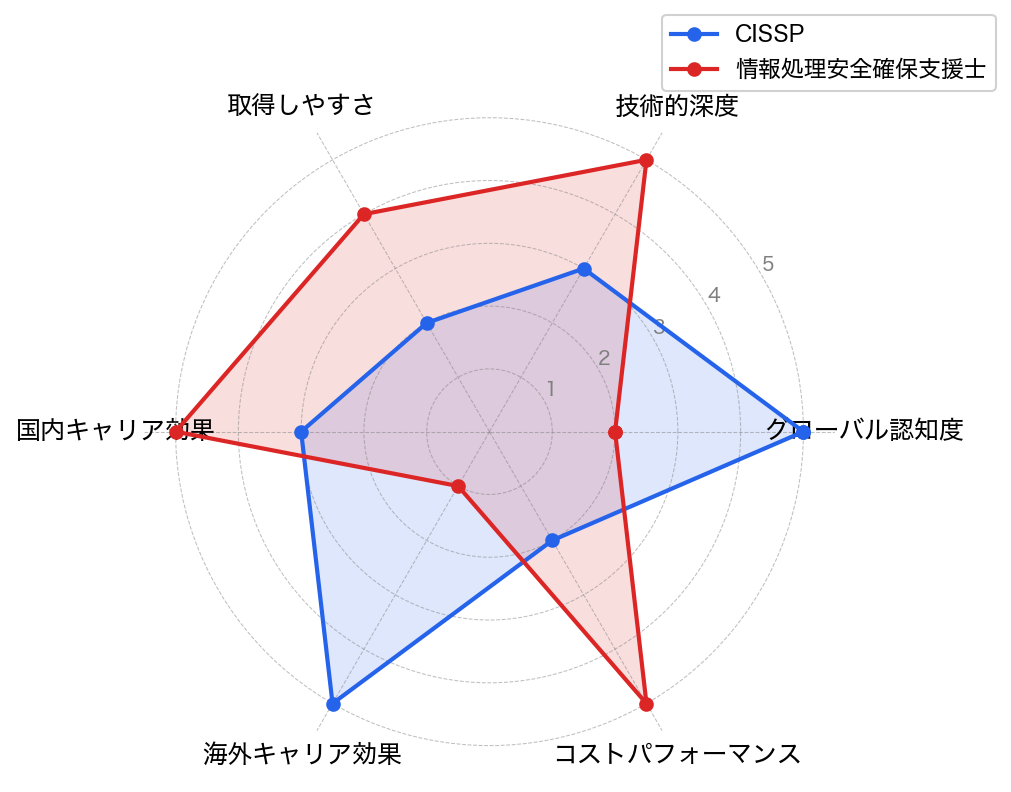
Difficulty and Study Period
What Makes CISSP Challenging
- Broad management perspective: The exam tests not just technical knowledge but risk management, governance, and business alignment
- English proficiency: While available in Japanese, most study materials and community resources are in English
- Experience-based questions: With 5 years of experience as a prerequisite, questions often require practical judgment rather than rote knowledge
- Adaptive testing: The CAT format adjusts difficulty based on performance, which can be mentally taxing
What Makes RISS Challenging
- Technical depth: Questions require implementation-level knowledge of networks, applications, and systems
- Written response format: The afternoon section demands reading comprehension and structured written answers under time pressure
- Japan-specific regulations: Candidates must understand domestic laws like the Unauthorized Computer Access Law and Personal Information Protection Act
- Morning I breadth: The general IT fundamentals section can be an unexpected hurdle for specialists
Estimated Study Time by Background
| Background | CISSP | RISS |
|---|---|---|
| 3+ years in security | 3–6 months | 2–4 months |
| IT experience only | 6–12 months | 4–8 months |
| IT beginner | Cannot meet requirements | 6–12 months |
Career Impact
Domestic (Japan)
- RISS:
- Specified in government and municipal procurement requirements
- Highly trusted as a national qualification; often qualifies for promotion or certification allowances
- Approximately 24,000 registered holders (as of 2025), making it relatively rare
- CISSP:
- Highly valued at foreign-affiliated and global companies operating in Japan
- Only about 4,000 CISSP holders in Japan, providing strong differentiation
- Directly relevant to CISO and security manager career paths
Global
- CISSP: Recognized worldwide as the premier information security certification. Listed in the U.S. Department of Defense Directive 8570 for IAM/IAT positions
- RISS: Limited recognition outside Japan, though it demonstrates Japanese security standards proficiency
Salary Impact
- CISSP holders earn an average of approximately $130,000 USD globally
- RISS holders may receive monthly certification allowances ranging from ¥10,000 to ¥50,000 depending on their employer
Recommended Certification Roadmap
Path 1: Early-Career Engineers
- Fundamental Information Technology Engineer Examination — Build a solid IT foundation
- Applied Information Technology Engineer Examination — Earn Morning I exemption for RISS
- RISS — Establish security specialization
- CISSP — Pursue after accumulating 5 years of experience for global recognition
Path 2: Experienced Professionals (5+ Years)
- Study for RISS and CISSP in parallel for maximum efficiency
- Earning RISS first covers a significant portion of CISSP’s technical domains
- Conversely, CISSP’s management perspective strengthens RISS afternoon exam preparation
Path 3: Global / Foreign-Company Focus
- Prioritize CISSP as the primary certification
- Add RISS if working within the Japanese market
- Consider CCSP (Cloud Security) or OSCP (Penetration Testing) for further specialization
Study Tips
- CISSP: Work through the official study guide (CBK) and practice exams repeatedly. Train yourself to “think like a manager” when answering questions
- RISS: Past exam practice is the most effective strategy. IPA publishes all past exams and answers for free on their official website
- Both: Follow security news and real-world incident reports regularly to build practical understanding
Conclusion
CISSP and RISS each bring distinct strengths as security certifications:
- Focused on a career in Japan → Start with RISS
- Aiming for a global career → Prioritize CISSP
- Want comprehensive coverage → RISS first, then CISSP
Holding both certifications positions you as a well-rounded security professional recognized both domestically and internationally.
Related Articles
- OAuth 2.0 and OpenID Connect: Fundamentals of Authorization and Authentication - Covers authentication/authorization protocols included in exam scope.
- Zero Trust Architecture: Principles, Components, and Implementation - Covers Zero Trust architecture, a trending security topic.
- RSA Encryption: Theory and Python Implementation - Covers the cryptographic foundations included in exam scope.