Introduction
Traditional network security was based on the perimeter defense model, protecting the enterprise network “boundary” with firewalls and VPNs. However, cloud adoption, remote work expansion, and BYOD have blurred the line between the trusted “inside” and untrusted “outside.”
Zero Trust Architecture (ZTA) is a security model based on the principle “Never trust, always verify.”
History of Zero Trust
| Year | Event |
|---|---|
| 2010 | John Kindervag at Forrester Research coined “Zero Trust” |
| 2014 | Google published BeyondCorp papers (eliminating VPN for internal access) |
| 2020 | NIST published SP 800-207 “Zero Trust Architecture” |
| 2021 | US Executive Order 14028 mandated Zero Trust for federal agencies |
The Structural Flaw in Perimeter Defense
Why does the “never trust, always verify” design philosophy matter so much? Tracing the limits of perimeter defense from an attacker’s point of view reveals the logical necessity behind it.
The Implicit Assumptions of the “Castle-and-Moat” Model
Perimeter defense is often compared to a castle-and-moat model. Firewalls and VPNs act as the moat; once traffic passes authentication and enters the castle (the internal LAN), it is implicitly trusted for every subsequent access. This design embeds two assumptions:
- Trust is based on network location (outside the perimeter is hostile, inside is friendly)
- Authentication only needs to happen once at the entrance, and that trust persists for the rest of the session
What Happens After a Breach
When these assumptions fail, the damage escalates quickly. A typical intrusion chain proceeds as follows:
- Initial compromise: malware is delivered to a single employee’s endpoint via phishing, or an attacker uses leaked VPN credentials for remote access
- Internal reconnaissance: because the interior is a “trusted network,” internal port scans and Active Directory queries proceed largely undetected
- Lateral movement / credential theft: the attacker moves to other hosts via internal file shares or RDP/SMB, harvesting cached credentials along the way
- Objective achieved: domain admin privileges are seized, enabling access to sensitive data or ransomware deployment
The structural flaw in perimeter defense is that once step 1 succeeds, steps 2 onward proceed almost entirely unverified. A VPN is often a bulk tunnel into the entire corporate network, with authorization granularity limited to the network level. Once a VPN connection is established, there is no mechanism to distinguish, on each individual resource access, whether the traffic comes from a legitimate user or an attacker using stolen credentials.
The Logic Zero Trust Resolves
The seven NIST SP 800-207 principles discussed below are each designed to break one link in this attack chain:
- Principle 2 (secure all communication) and Principle 6 (strict authentication/authorization before access) destroy the very assumption behind step 2 — “internal, so unverified.” Even LAN traffic is encrypted and every resource requires authentication, so there is no segment an intruder can traverse unchallenged.
- Principle 3 (per-session access grants) and Principle 4 (dynamic policy) prevent step 3 — “one stolen credential enables lateral movement across multiple resources.” Authorization is re-evaluated per resource and per session, so even if credentials stolen from one device remain valid, a low device-health score blocks access to other resources.
- Principle 5 (continuous monitoring of integrity) provides the path by which a compromised endpoint is automatically quarantined as its trust score drops.
In short, Zero Trust structurally eliminates perimeter defense’s single point of failure — “breach the entrance and the interior is exposed” — by distributing authorization decisions to the level of individual resources and sessions. Micro-segmentation blocking lateral movement functionally is a direct consequence of this same logic, and dynamic policy minimizes how long a single successful breach can persist.
Core Principles (NIST SP 800-207)
NIST SP 800-207 defines seven core principles:
All data sources and computing services are considered resources
- Personal devices accessing enterprise resources are managed as resources
All communication is secured regardless of network location
- Internal LAN traffic is encrypted and authenticated
Access to individual resources is granted on a per-session basis
- No persistent access from a single authentication
Access is determined by dynamic policy
- User ID, device state, location, time, behavioral patterns are holistically evaluated
Integrity and security posture of all assets are monitored and measured
- Unpatched or misconfigured devices receive lower trust scores
Authentication and authorization are strictly enforced before access
- Multi-factor authentication (MFA) and least privilege principle
Collected data is continuously used to improve security posture
- Log analysis, anomaly detection, and policy optimization cycles
Key Components
Logical Architecture
User/Device
    ↓
[Policy Enforcement Point (PEP)]  ← Access control point
    ↓
[Policy Administrator (PA)]       ← Establishes/terminates connections
    ↓
[Policy Engine (PE)]              ← Access decision brain
    ↑
  ┌─────────────────┐
  │ Data Sources      │
  │ · Identity Provider (IdP) │
  │ · SIEM / Log Analysis     │
  │ · Threat Intelligence     │
  │ · Device Management (MDM) │
  │ · Compliance DB           │
  └─────────────────┘
| Component | Role |
|---|---|
| Policy Engine (PE) | Makes access decisions based on context |
| Policy Administrator (PA) | Establishes/terminates sessions per PE decisions |
| Policy Enforcement Point (PEP) | Gateway that enforces actual access control |
| Identity Provider (IdP) | User authentication and attribute provision |
| SIEM | Security event collection and correlation analysis |
| MDM/EDR | Device health and security posture assessment |
Verification: Simulating a Policy Engine’s Authorization Decisions with Open Policy Agent
The Policy Engine (PE) combines “user authentication state,” “device health,” “authorization for the requested resource,” and “context (time, location, etc.)” to make dynamic access decisions. We implemented this decision logic in Rego, the policy language of the widely-used authorization engine Open Policy Agent (OPA), and actually executed it against several input scenarios to confirm the allow/deny outcomes.
package zerotrust.authz

import rego.v1

default allow := false

# The authorization decision the PEP queries the Policy Engine for:
# allow = true only if the user is authenticated, the device is
# compliant, the least-privilege role permits the resource, AND
# the access time/location is normal (never trust, always verify)
allow if {
	input.user.authenticated == true
	input.user.mfa_verified == true
	device_compliant
	role_permits_resource
	within_business_hours
}

device_compliant if {
	input.device.os_patch_level == "current"
	input.device.edr_healthy == true
	input.device.managed == true
}

role_permits_resource if {
	some role in input.user.roles
	permission := data.role_permissions[role]
	input.resource in permission.allowed_resources
}

within_business_hours if {
	input.context.hour_utc >= 0
	input.context.hour_utc < 24
	not input.context.is_anomalous_location
}

# Deny reasons are returned to the PEP for audit logging and user feedback
deny_reasons contains "device_not_compliant" if not device_compliant
deny_reasons contains "role_denied" if not role_permits_resource
deny_reasons contains "anomalous_context" if not within_business_hours
We ran four scenarios against this policy using the OPA CLI (opa eval):
| Scenario | MFA verified | Device health | Requested resource | Context | allow | deny_reasons |
|---|---|---|---|---|---|---|
| 1. Normal case | yes | healthy | in scope (engineer→repo) | normal | true | [] |
| 2. Non-compliant device | yes | unhealthy (EDR down, unpatched) | in scope | normal | false | ["device_not_compliant"] |
| 3. Out-of-scope resource | yes | healthy | out of scope (finance→repo) | normal | false | ["role_denied"] |
| 4. Anomalous context | yes | healthy | in scope | connection from unusual location | false | ["anomalous_context"] |
The execution results (opa eval --format pretty -d policy.rego -d data.json -i inputN.json 'data.zerotrust.authz.allow') matched the design in every case:
=== input1_allow ===       => true,  deny_reasons: []
=== input2_device_fail ===  => false, deny_reasons: ["device_not_compliant"]
=== input3_role_fail ===    => false, deny_reasons: ["role_denied"]
=== input4_anomalous ===    => false, deny_reasons: ["anomalous_context"]
This confirms that NIST SP 800-207’s Principle 4 (dynamic policy-based access decisions) and Principle 6 (strict authentication/authorization before access) are implemented, at the code level, not as a single monolithic AND-rule over multiple signals but as a combination of independent checks — authentication, device health, authorization, and context. Notice that scenarios 2–4 all have “MFA verified: yes” — the credentials themselves are valid — yet access is still denied. Under a perimeter defense model, traffic carrying valid credentials would (once past the VPN) reach any other resource unchallenged; under Zero Trust, failing even one check blocks access regardless of how many other checks pass. This is the implementation-level confirmation of the point made earlier: stolen credentials alone are not sufficient for lateral movement.
Comparison with Perimeter Defense
| Aspect | Perimeter Defense | Zero Trust |
|---|---|---|
| Trust basis | Network location | Verified identity + context |
| Internal network treatment | Implicitly trusted | Never trusted, always verified |
| Access control | Network-level | Resource-level |
| VPN requirement | Essential | Unnecessary (per-application access) |
| Lateral movement defense | Limited | Suppressed via micro-segmentation |
| Visibility | Boundary traffic only | All communications visible |
| Remote work support | VPN-dependent | Same policy regardless of location |
CISA Zero Trust Maturity Model (ZTMM v2.0)
Where NIST SP 800-207 defines what must be satisfied, the Zero Trust Maturity Model version 2.0 (ZTMM), published by the US Cybersecurity and Infrastructure Security Agency (CISA) in April 2023, provides a practical yardstick for where an organization currently stands and what to do next.
ZTMM v2.0 expanded the original three-stage model (2021) by adding an Initial stage, for a total of four stages. This addressed a real practical gap between “manual, siloed controls” and “full automation”:
- Traditional: manual configuration and lifecycle management, static security policies, implicit trust
- Initial: early automation and cross-pillar coordination begins; partial adoption of dynamic policy
- Advanced: automated controls, integrated visibility, policy enforcement driven by real-time signals
- Optimal: fully automated dynamic policy enforcement, continuous validation, near-zero static trust
The five pillars assessed are Identity, Devices, Networks, Applications and Workloads, and Data. Three cross-cutting capabilities — Visibility & Analytics, Automation & Orchestration, and Governance — underpin all five.
The figure below summarizes representative characteristics of the four stages for each pillar (condensed from CISA ZTMM v2.0, April 2023):
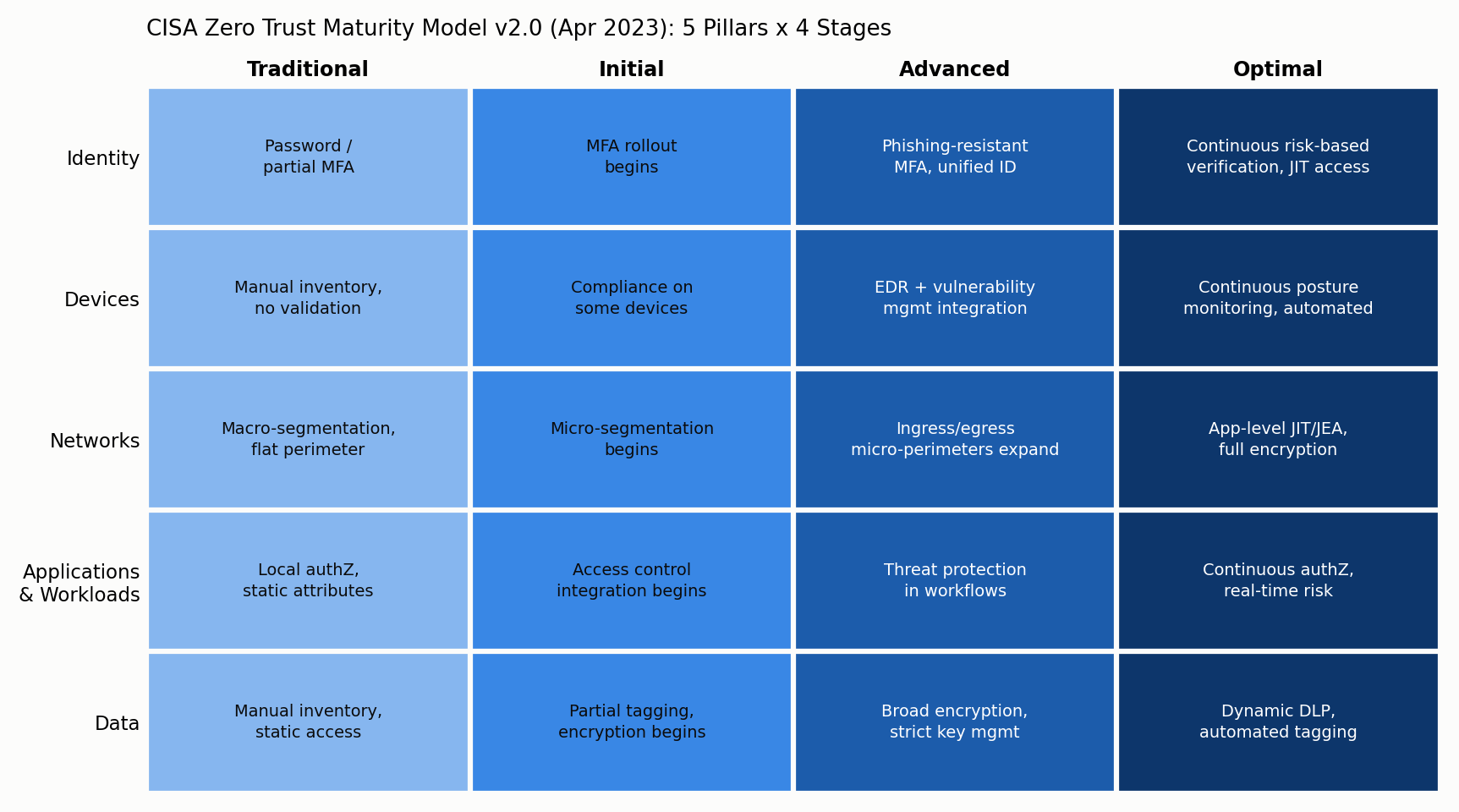
For the Networks pillar, for example, maturity progresses from Traditional’s “macro-segmentation with a large perimeter,” through Advanced’s “expanding ingress/egress micro-perimeters,” to Optimal’s “dynamic micro-segmentation scoped to application profiles with Just-in-Time/Just-Enough-Access (JIT/JEA) connectivity.” This is precisely the concrete endpoint of “structurally preventing lateral movement” discussed earlier.
Most organizations are not at the same stage across all five pillars — it’s common to be, say, “Advanced on Identity but still Traditional on Data.” ZTMM is designed to make this unevenness visible and to prioritize investment toward whichever pillar lags furthest behind.
Implementation Approaches
Identity-Centric
Strengthen identity management and MFA for trust-based access control.
- Universal SSO + MFA deployment
- Contextual authentication (device, location, time, risk score)
- Just-in-Time (JIT) access
Network-Centric
Use micro-segmentation to divide networks finely and prevent lateral movement.
- VLAN / firewall rule granularization
- Software-Defined Networking (SDN)
- East-west traffic inspection
Software-Defined Perimeter (SDP)
Control access at the application level, hiding the network itself. Resources are invisible until authentication succeeds.
Phased Implementation Plan
| Phase | Measures | Goal |
|---|---|---|
| Phase 1 | Identity foundation | Deploy MFA for all users, SSO integration, identity governance |
| Phase 2 | Device trust establishment | Deploy MDM/EDR, device health checks, compliance verification |
| Phase 3 | Micro-segmentation | Network segmentation, per-application access control |
| Phase 4 | Continuous monitoring | SIEM integration, anomaly detection, automated policy adjustment |
Implementation Challenges (Practical Pitfalls)
Legacy System Integration
Older systems may not support modern authentication protocols (OAuth 2.0, SAML). Proxy or adapter layers may be needed — and in NIST NCCoE’s 2025 implementation guide SP 1800-35 (discussed below), many of the 19 example architectures, built from 24 vendor products, include a gateway or adapter layer specifically to integrate legacy systems.
Increased Authorization Latency
Under perimeter defense, once a VPN connection is established, subsequent traffic incurs almost no additional authorization overhead. Under Zero Trust, a Policy Engine lookup can occur on every single resource access. In a microservices architecture with dozens of chained service-to-service calls, round-tripping to the PE on every hop causes latency to accumulate across the chain. In practice, mitigations include (1) caching authorization decisions with a short TTL, and (2) deploying the PE as a sidecar close to the request path (a concrete implementation pattern described in NIST SP 800-207A, discussed below, using a service-mesh architecture). However, a longer cache TTL introduces a delay before device state changes (e.g., transitioning into non-compliance) are reflected — a direct trade-off against the “always verify” principle.
Availability Degradation from Overly Strict Policy
Context-based authorization can mechanically deny even a legitimate user for “access from an unusual location” or “access outside business hours.” Scenario 4 in the OPA simulation above is exactly this case — authentication and device health were both fine, yet the request was denied purely on context. Overly strict policy can block legitimate access from an on-call engineer responding to an incident or an employee traveling for business, degrading availability. A break-glass procedure — a human-mediated, temporary policy relaxation for emergencies, paired with audit logging — is essential.
The Policy Engine as a Single Point of Failure
While Zero Trust eliminates perimeter defense’s single point of failure (breach one point at the boundary and the entire interior is exposed), centralizing authorization decisions in a Policy Engine can introduce a new one. If the PE goes down or becomes overloaded, an implementation that applies Principle 6 (strict authentication/authorization before access) literally will fail closed — deny all access — potentially halting business entirely. Mitigations include PE redundancy (distributed across multiple regions), graceful degradation via caching of recent authorization decisions, and SLA monitoring. CISA’s ZTMM also evaluates this kind of availability design as part of Automation & Orchestration maturity.
Cost and Complexity
Phased deployment is recommended, starting with high-ROI areas (privileged access management, critical data protection). Using the ZTMM’s five-pillar assessment to identify the pillar that lags furthest behind, and starting there, is also an effective approach.
Recent Standards Developments (2023 and Later)
Zero Trust standards and guidance have continued to evolve since 2023:
- CISA Zero Trust Maturity Model v2.0 (published April 2023): added an Initial stage to the prior three-stage model, establishing the current four-stage, five-pillar model.
- NIST SP 800-207A (finalized September 13, 2023): “A Zero Trust Architecture Model for Access Control in Cloud-Native Applications in Multi-Cloud Environments.” It presents a network-tier/identity-tier authorization model for microservices in multi-cloud and hybrid environments, using API gateways, sidecar proxies, and SPIFFE-based service identity — giving concrete implementation guidance for the latency mitigation (deploying the PE as a sidecar) discussed above.
- NIST SP 1800-35 (finalized June 10, 2025): an implementation guide from NCCoE (the National Cybersecurity Center of Excellence), built and validated in collaboration with 24 vendors across 19 example Zero Trust architectures. It serves as a practitioner-facing resource bridging the gap between theory (SP 800-207) and implementation.
- CISA’s “Journey to Zero Trust” microsegmentation guidance, Part One (published July 29, 2025): the first installment of a new series aimed at federal agencies, covering the planning and rollout of micro-segmentation — a practical guide to the lateral-movement countermeasures discussed in “The Structural Flaw in Perimeter Defense” above.
Related Articles
- OAuth 2.0 and OpenID Connect: Fundamentals of Authorization and Authentication - The authentication protocol foundation for Zero Trust.
- RSA Encryption: Theory and Python Implementation - Cryptographic foundations used in Zero Trust.
- Security Certification Comparison: CISSP vs Japan’s Registered Information Security Specialist - Certification paths related to Zero Trust.
- CISSP: Comparing Major Security Governance Frameworks - Understand Zero Trust’s position within the broader security framework landscape.
- Comparison of Major Security Models - Relationship between access control models like Bell-LaPadula and Zero Trust.
- Email Security: Authentication and Encryption Technologies - Email authentication as part of Zero Trust.
- Micro Hardening Training Participation Report - Hands-on security training experience.
References
- Rose, S., Borchert, O., Mitchell, S., & Connelly, S. (2020). NIST SP 800-207: Zero Trust Architecture . National Institute of Standards and Technology.
- Chandramouli, R., & Butcher, Z. (2023). NIST SP 800-207A: A Zero Trust Architecture Model for Access Control in Cloud-Native Applications in Multi-Cloud Environments . National Institute of Standards and Technology.
- NIST NCCoE (2025). SP 1800-35: Implementing a Zero Trust Architecture . National Institute of Standards and Technology.
- CISA (2023). Zero Trust Maturity Model, Version 2.0 . Cybersecurity and Infrastructure Security Agency.
- CISA (2025). Microsegmentation in Zero Trust, Part One: Introduction and Planning . Cybersecurity and Infrastructure Security Agency.
- Ward, R., & Beyer, B. (2014). “BeyondCorp: A New Approach to Enterprise Security”. ;login:, 39(6).
- Executive Order 14028 (2021). “Improving the Nation’s Cybersecurity”.
- Open Policy Agent. Rego Policy Language Documentation .