Introduction
Technical books are a mixed bag. Some books that were the talk of the town fade into obscurity within a few years, while others remain in active use on the job more than a decade after their first edition. This article selects 10 books of the latter kind — books whose value does not erode over time — across seven fields, and introduces them from a working engineer’s perspective.
The selection criteria come down to three points. First, whether the book is a genuine classic still in active use on the job — books that multiple teams and multiple generations of engineers actually keep referring to, rather than one-off trend books. Second, whether the book teaches its subject systematically, building up from first principles rather than offering a disconnected grab-bag of tips. Third, whether the book still holds up as of 2026. Technology trends shift, but foundations such as code readability, OS basics, version control, design principles, and security thinking tend not to go stale. Ten books across seven fields — from code quality to security certifications — met all three criteria.
Readers who want to systematically learn signal processing, machine learning, time-series analysis, state estimation, and cryptography in Python should also see the companion article, 12 Recommended Books for Learning Signal Processing, Machine Learning, and Control in Python (2026, by Level) . This article is not limited to a specific implementation field; instead, it covers books for building a broader foundation as an engineer, spanning web development, infrastructure, design, and security.
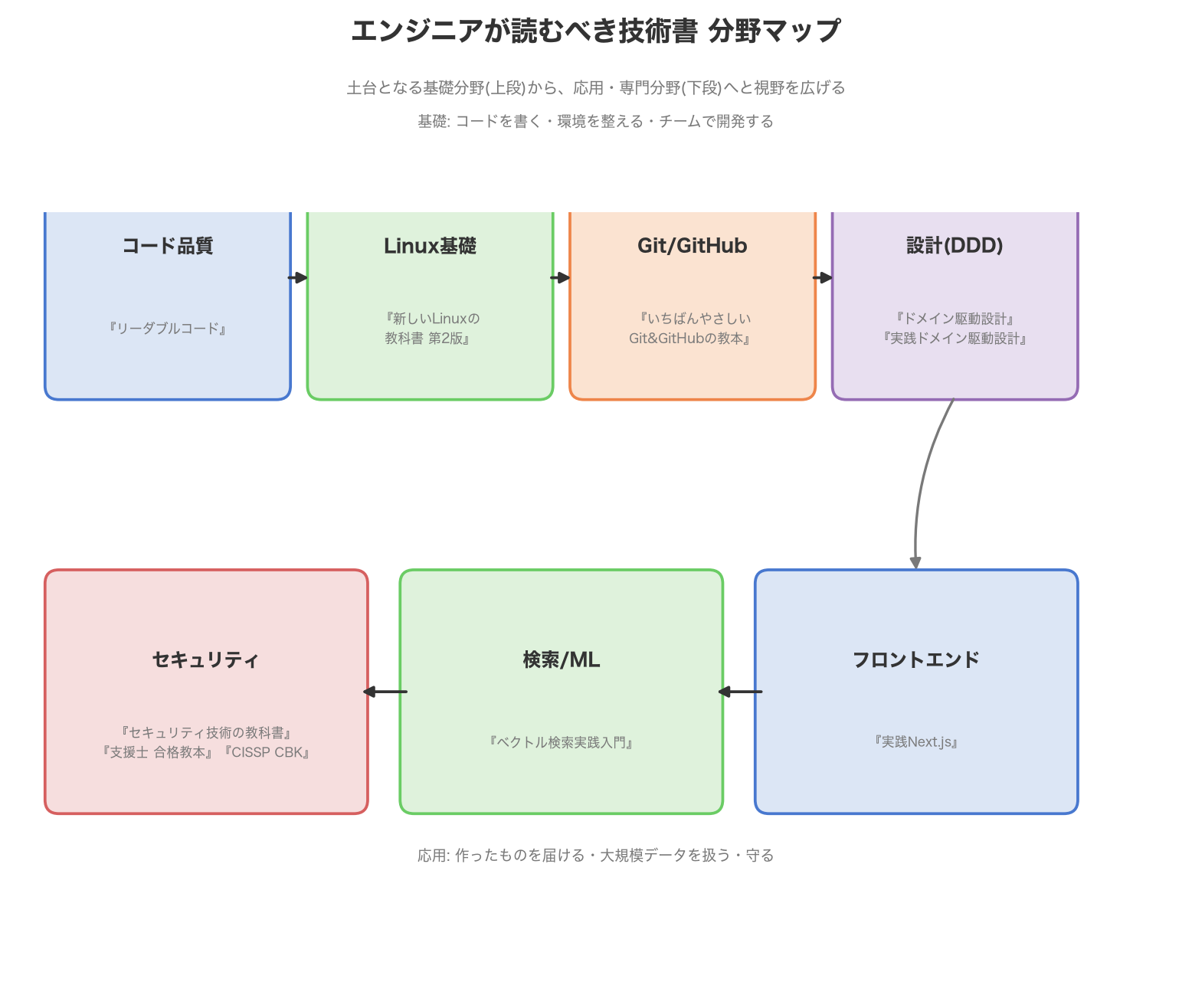
The figure below organizes the seven fields covered in this article in order of increasing scope, from foundational to applied/specialized. On top of a foundation of writing code, setting up your environment, and developing as a team, applied skills build up: shipping what you build (frontend), handling large-scale data (search/ML), and protecting it (security).
Code Quality
Whatever language or framework you use, your code ultimately gets read by other people. Start with a book that systematically teaches what makes code readable.
The Art of Readable Code
This classic covers the elements that determine readability — naming, comments, control flow, and function decomposition — with concrete code examples throughout. Because it deals in principles that are independent of any particular language or framework, it offers something to learn whether you’re a new hire or a veteran. Each chapter is short and self-contained, so it also works well as a reference to dip into rather than read cover to cover. Rereading it before and after code review, as a way to put into words why one way of writing something is more readable than another, has become a common practice among engineers. See this blog’s summary of “The Art of Readable Code” for an overview of its structure.
Linux Basics
Whether you’re doing web development or infrastructure work, Linux sits on the other side of the server. Even with today’s rich GUI tooling, whether you systematically understand the command line and permissions makes a real difference in how fast you can respond to trouble.
新しいLinuxの教科書 第2版 (The New Linux Textbook, 2nd Edition)
This introductory book teaches Linux fundamentals hands-on — the filesystem structure, basic shell operations, permissions, and process management. It suits engineers who want to move past “copy-pasting commands without really knowing why” and understand the mechanics behind them. The 2nd edition has been updated for current environments, making it a solid read not only for beginners but also for mid-level engineers checking their systematic knowledge for gaps. For a deeper dive into permissions specifically, see this blog’s Complete Guide to Linux Permissions .
Git/GitHub
Version control is now an essential skill for engineers, but memorizing commands piecemeal doesn’t prepare you for the real sticking points in practice — merge conflicts, rebasing, and the like. Understanding the underlying model is ultimately the faster path.
いちばんやさしいGit&GitHubの教本 第3版 (The Easiest Textbook for Git & GitHub, 3rd Edition)
This introductory book explains Git’s core concepts through to team-development workflows using GitHub, with plenty of diagrams. It also covers practices specific to team development, such as branching and pull requests, making it suited not just to solo learning but to learning with real collaboration in mind. The 3rd edition has been updated for GitHub’s current UI and workflows, so it’s an approachable first book for engineers about to join a team-based development project. If you get stuck configuring the connection to GitHub, also see this blog’s How to Set Up SSH Access to GitHub .
Design (Domain-Driven Design)
Once you can write code, the next step is learning design that holds up under change. Domain-Driven Design (DDD) has a reputation for being hard to approach, but reading from the introductory book to the classic, in that order, makes it easier to absorb.
Domain-Driven Design (Eric Evans)
This is the original text that proposed DDD itself, systematically laying out its central concepts: the ubiquitous language, entities, value objects, aggregates, and bounded contexts. It’s a fairly abstract book and can feel difficult on a first read, but it’s essential for any engineer who wants to reframe software design around the question of how to translate domain knowledge into code. Reading a more implementation-focused book first and then returning to this one tends to make the connections between concepts click into place.
Implementing Domain-Driven Design (Vaughn Vernon)
This practical companion translates the original concepts into concrete implementation patterns and sample code. It addresses the questions that come up when applying DDD in practice — how to design aggregates, how to combine DDD with event-driven architecture — and works well for readers who found Evans’s book conceptually clear but struggled to picture the implementation. You can read it after Evans’s book, or read it first to get a feel for the implementation and then return to Evans’s more abstract discussion — either direction works. For a focused look at the aggregate concept, see this blog’s What Is a DDD Aggregate?
Frontend
Once you have backend design principles down, it’s worth keeping up with the delivery side too — the frontend. Next.js’s App Router in particular represents a major shift in the mental model for React development, which makes a systematic guide to it valuable.
実践Next.js (Next.js in Practice)
This hands-on book centers on Next.js’s App Router, covering the split between Server Components and Client Components, data fetching, and rendering strategies. It’s useful both for engineers weighing a migration off the Pages Router and for those starting a new project on the App Router, filling in the design judgment calls that official documentation alone doesn’t always make clear. The question of exactly where to draw the boundary between Server Components and Client Components is one of the trickiest calls in practice, and this book dives into it with concrete examples. To get a feel for that boundary first, see this blog’s What Is ‘use client’?
Search/ML
With the spread of generative AI, knowledge of vector search is no longer something only a handful of specialists need. It requires a different way of thinking from full-text search, which makes a systematic Japanese-language guide to the subject valuable.
ベクトル検索実践入門 (A Practical Introduction to Vector Search)
This practical book covers the fundamentals of vector search, how approximate nearest neighbor (ANN) algorithms work, and how to use real vector databases. As building generative AI applications that include RAG (retrieval-augmented generation) becomes routine, it suits engineers who want to understand what’s happening behind the scenes of search. Because it pairs theory with implementation examples, it’s a good next step for readers who have gotten a vector database running but don’t yet understand how it works. For a deeper look at how ANN algorithms actually work, see this blog’s article on HNSW, IVF, PQ, and DiskANN (in Japanese), which explains the mechanics of approximate nearest neighbor search in detail.
Security
Finally, security is a field no engineer can avoid, regardless of specialty. We introduce one book for grasping the overall landscape, followed by the standard domestic certification guide, and then the standard guide for a globally recognized certification.
セキュリティ技術の教科書 第2版 (The Security Technology Textbook, 2nd Edition)
This book systematically organizes the broad landscape of security — cryptography, authentication, network security, and vulnerability countermeasures — with plenty of diagrams. Because it covers the underlying technology across the board without tying itself to any specific attack technique or product, it works well both as a map to read before starting certification study and as a way to organize knowledge picked up piecemeal on the job. In a field this dense with terminology, getting an overview first makes learning individual topics afterward much more efficient. For more on how to approach security study in general, see this blog’s How to Pass the Registered Information Security Specialist (RISS) Exam .
Registered Information Security Specialist (RISS) Exam Guide
Aimed at candidates for Japan’s national Registered Information Security Specialist exam, this standard prep book systematically covers the morning and afternoon exam scope. Although it’s oriented toward exam prep, the scope itself effectively functions as a checklist of security knowledge worth having on the job, so it’s useful for a knowledge audit even if you’re not pursuing the certification. It’s built to be paired with past-exam practice, and it’s a common choice as the primary material for self-study candidates.
CISSP CBK Official Study Guide (New Edition)
This is the official guide covering the CBK (Common Body of Knowledge) for CISSP, an internationally recognized security certification. It spans eight domains, including Security and Risk Management, Asset Security, and Security Architecture, and suits engineers or security professionals who want to learn a body of security management knowledge that’s recognized globally. It’s a substantial read that takes real time to get through, but as the official material giving an overview of the whole body of knowledge, it’s worth consulting not only for CISSP candidates but for anyone involved in security governance. For an organized look at frequently tested governance frameworks, see this blog’s CISSP Security Governance Prep .
A Suggested Reading Order
The books worth prioritizing shift with experience. As a rough guide:
- Year 1 (just starting to write code): Start with The Art of Readable Code to build a sense of what makes code readable, and work through 新しいLinuxの教科書 第2版 and いちばんやさしいGit&GitHubの教本 第3版 in parallel to shore up your development environment fundamentals. These three books form a foundation for daily development regardless of language or framework.
- Year 3 (trusted to own feature development on your own): Pick up a field-specific practical book like 実践Next.js to learn current frontend design patterns, while building design skills with Domain-Driven Design and Implementing Domain-Driven Design. Also read セキュリティ技術の教科書 第2版 once to get an overview of security — it will make later, more focused study more efficient.
- Lead (responsible for design decisions and team technical direction): Apply the two DDD books to real design decisions, while keeping an eye on newer areas such as vector search via ベクトル検索実践入門. For security, if you want a certification to formally demonstrate systematic knowledge, 情報処理安全確保支援士 合格教本 is the option for a domestic career track, and 新版 CISSP CBK公式ガイドブック is the option if you’re also considering a global career track.
Frequently Asked Questions (FAQ)
Which book should I read first?
Choose based on your years of experience and whatever problem you’re facing right now. If code review keeps flagging the same issues, start with The Art of Readable Code; if you’re struggling with design, start with the two DDD books. Starting with “the book closest to your current problem” makes it easier to stay motivated and to retain what you learn. If nothing stands out, use the “Suggested Reading Order” above as a guide by years of experience.
Ebook or print — which is better?
There’s no universal answer; it’s more realistic to mix formats depending on use. Ebooks are highly searchable and portable, which suits books you use as a dictionary-style reference or read in small chunks during a commute. Print books, on the other hand, make it easier to compare diagram-heavy pages side by side and to scribble sticky notes and margin comments — many readers find print a better fit for books like the DDD titles, where you move back and forth between abstract concepts. Try both and settle into whichever fits your reading style, switching as needed.
Do you have recommendations for Python machine learning books?
This article focuses on cross-disciplinary technical books spanning web development, infrastructure, design, and security, so books specific to Python-based machine learning are out of scope here. If you want to systematically learn signal processing, machine learning, time-series analysis, state estimation, and cryptography in Python, the companion article 12 Recommended Books for Learning Signal Processing, Machine Learning, and Control in Python (2026, by Level) covers 12 books by level — see that article instead.
Summary
- We curated 10 classic, still-relevant technical books across seven fields: code quality, Linux basics, Git/GitHub, design (DDD), frontend, search/ML, and security.
- The selection criteria were: (1) genuine, still-active use on the job, (2) whether the book teaches its subject systematically, and (3) whether it still holds up as of 2026.
- We gave a suggested reading order by years of experience: Year 1 focuses on the three foundational fields; Year 3 adds design and frontend; leads should prioritize applying design in practice and pursuing security certifications.
- For books specific to Python and machine learning, see the companion article 12 Recommended Books for Learning Signal Processing, Machine Learning, and Control in Python (2026, by Level) .
Related Articles
- The Art of Readable Code, Summarized - An overview of the structure of this classic on code quality.
- The Complete Guide to Linux Permissions - The article-side entry point for going deeper into Linux basics.
- How to Set Up SSH Access to GitHub - Covers common sticking points in real-world Git/GitHub setup.
- What Is a DDD Aggregate? - A deep dive into DDD’s central concept of the aggregate.
- What Is ‘use client’? - Explains the Server/Client Component boundary in Next.js App Router.
- HNSW, IVF, PQ, and DiskANN explained (in Japanese) - A deep dive into the algorithms behind vector search.
- How to Pass the Registered Information Security Specialist (RISS) Exam - Study methods for Japan’s domestic security certification.
- CISSP Security Governance Prep - Organizes frequently tested themes for the global security certification.
- 12 Recommended Books for Learning Signal Processing, Machine Learning, and Control in Python (2026, by Level) - The companion article focused on Python and machine learning.
Related Tools
- DevToolBox - Free Developer Tools - Over 90 developer tools including JSON formatter and regex tester.
- CalcBox - Everyday Calculators - Over 60 calculators including statistics and frequency conversion.